We speak the same language.
So why can't we understand each other?
Semantic Babel explores what happens when people keep using the same words but attach different meanings to them, and how families, teams and communities can rebuild understanding without demanding agreement.
Disagreement does not require dehumanization. Understanding does not require agreement.
Same word.
Different dictionary.
Sometimes conflict is not really about the conclusion. It begins earlier, when two people attach different definitions, assumptions or moral weight to the same word. Then each responds to the meaning in their own head instead of the meaning the other person intended.
“Dad, sometimes I don't feel safe talking to you.”
Daniel hears: “You are a physical threat to me.” Maya means: “I don't feel emotionally comfortable saying what I think around you.”
One word. Two dictionaries.
Their fictional story reveals the emotional cost of semantic misunderstanding without turning either person into the villain.
From Babel
to Coherence
The full keynote maps a path from shared meaning, through fragmentation and relational separation, toward a practical way of restoring accurate understanding. The website gives you the map. The keynote and workbook teach you how to travel it.
Semantic Commons
Enough shared meaning to reason together.
Semantic Babel
Same words, materially different meanings.
Babel Cascade
Meanings become judgments, motives and distance.
Semantic Reconciliation
Discover meaning before judging the person.
Semantic Coherence
Accurate understanding despite disagreement.
The Right-to-Debate Test
Before rebuttal, can both people do these four things?
- 1State the other person's position accurately.
- 2Define important terms as the other person uses them.
- 3Identify what they actually agree about.
- 4Identify the precise point where agreement ends.
Representation before rebuttal. Never argue against a position until its owner recognizes it in your description.

The Babel Cascade
Semantic divergence
Different meanings for the same words.
Interpretive divergence
The same event starts looking completely different.
Moral judgment
The other person's view starts to look morally suspect.
Motive attribution
“You see it differently” becomes “You don't care.”
Relational separation
Avoid. Mute. Stop calling. Walk away.
The complete Semantic Reconciliation process is taught in the keynote and expanded through exercises in the workbook.
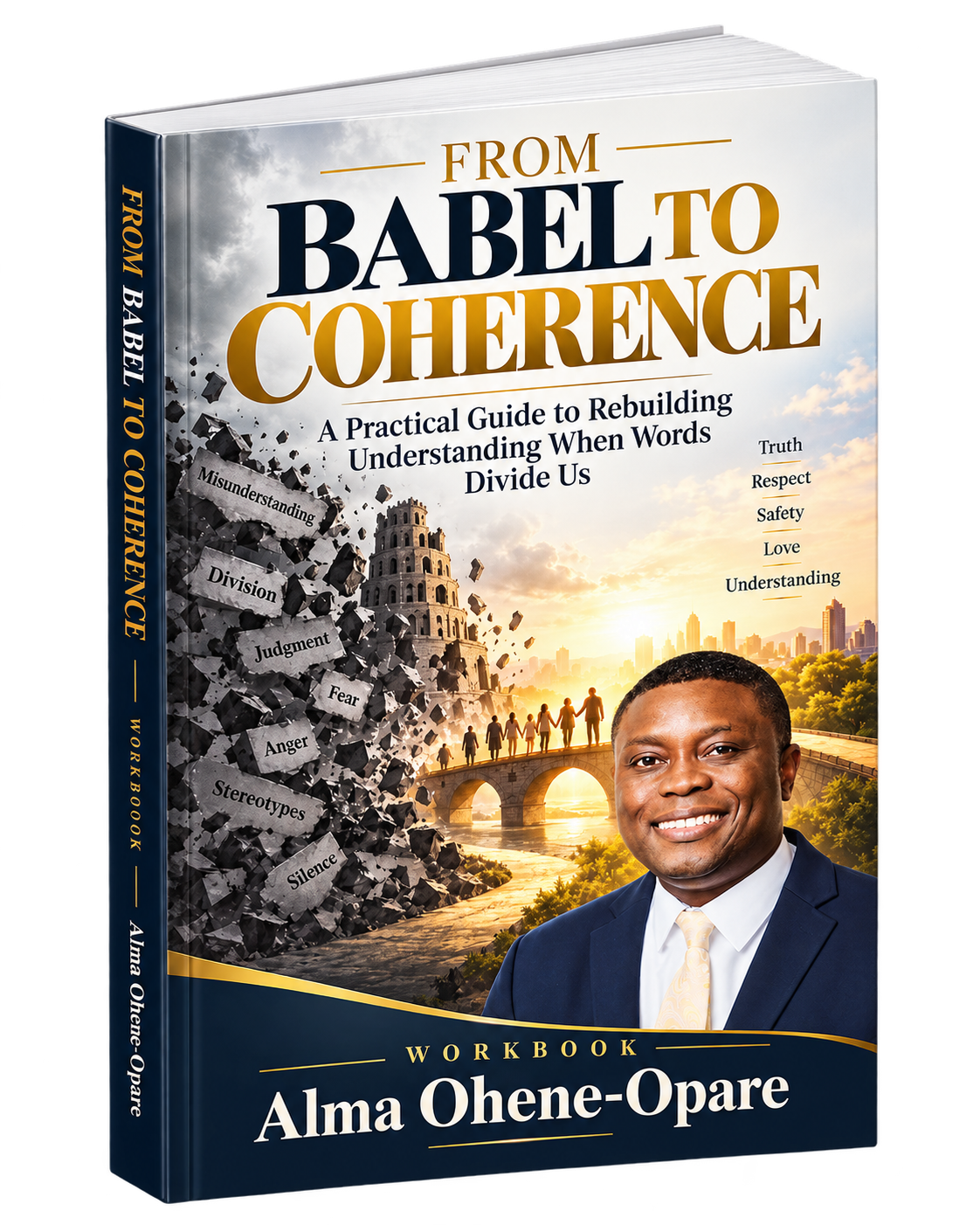
From Babel to Coherence
A practical guide for people who believe an important relationship is slipping into Semantic Babel and want a structured path back to understanding.
- Diagnose patterns of semantic friction and relational withdrawal.
- Find the “load-bearing word” underneath recurring arguments.
- Separate semantic, factual, moral and preference disagreements.
- Build shared working definitions without surrendering conviction.
- Practice the Right-to-Debate Test and Representation Before Rebuttal.
- Measure progress toward Semantic Coherence.
Connect this button to your checkout or workbook product page before publishing.

Alma Ohene-Opare
Semantic Babel is not a lecture about eliminating disagreement. It is an invitation to make disagreement more accurate. Alma uses story, humor, audience participation and a practical communication framework to help people uncover the argument underneath the argument.
The keynote is designed for leadership, communication, conflict-resolution, education, family, faith, workplace culture and civil-discourse audiences. It can be delivered as a high-impact keynote or expanded into an interactive workshop.
Give your audience a better way to disagree.
Book Alma for a keynote that is emotionally engaging, intellectually challenging and immediately practical. Your audience will leave with language they can use in families, workplaces, teams and communities the same day.
What organizers can expect
- A compelling story-driven keynote
- A politically neutral communication framework
- Memorable concepts audiences can repeat
- Optional interactive exercises and workshop formats
- A companion workbook for continued application